Multimedia for the sake of it

There is much talk now about multimedia, and any news website which doesn't incorporate multimedia, and lots of it, is seen as backward and resistant to change. It seems that in the rush to be seen as new and current and up-to-date and in a desperate attempt to make newspaper websites profitable, some sites are using multimedia for the sake of using multimedia.

The Guardian website has a lot of audio and video and picture slideshows, but I wonder how much is actually worth uploading.

Many of the videos have shots that wouldn't make it on the broadcast news, or the camera is shaky or there are zooms in or out. Other videos are very brief, a few seconds of landscape shots with some titles added in. Some don't even have those captions, and seem to be completely pointless, other than to prove to the world that the Guardian knows how to upload videos.

I'm sure there are other newspapers guilty of this, but the Guardian happened to spring to mind. I find it very off-putting, not knowing when I click on a video whether it's worth the effort, or whether it'll be worthless.

Too many newspapers are focusing on quantity over quality when it comes to incorporating multimedia into their sites.
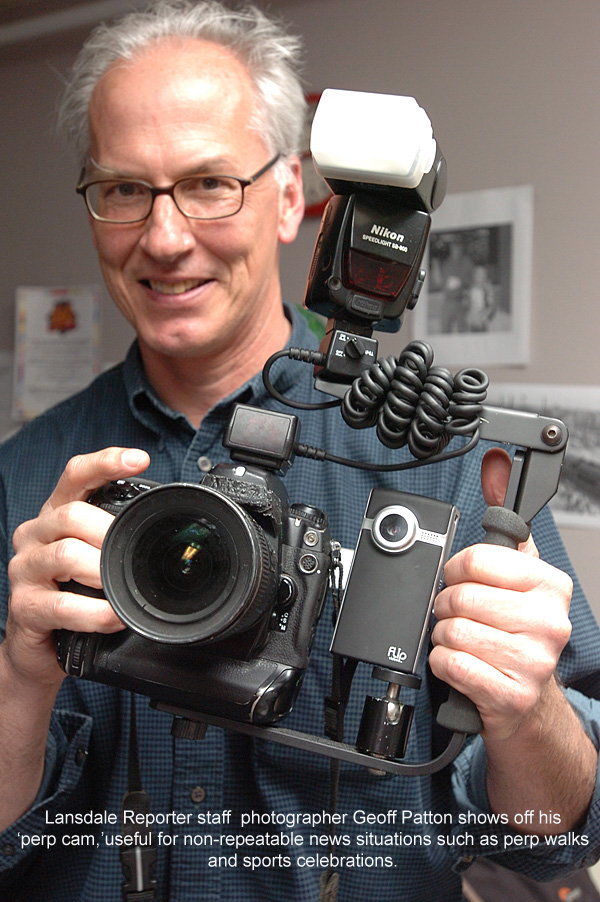
Multimedia increasing workload for journalists


I spotted this a while ago, when Jeff Jarvis tweeted about it.

I thought it was interesting in light of what Denis wrote about MoJos, or mobile journalist, and how dependent on expensive equipment they were.

It also ties in to what I said during the presentation, about how journalists are expected to do more work for the same amount of money (or less, in some cases) as they were paid before multimedia became hugely important.

I seriously doubt Geoff Patton is being paid more money for producing video and photographs, although he is doing a second person's job. He may have it handy thanks to the "perp cam" but he also has to edit twice as much, and possibly upload it all to the web as well, and we must remember that there are many journalists who cannot afford equipment like the perp cam.

Convergence & Technological determinism

CONVERGENCE
The new buzz word in journalism, it is becoming the norm for journalists to write copy, record footage and audio and do live link ups. The internet is providing the platform for all forms of media to come together.


Digital natives; a key advertising demographic. They want hyperlinks to audio and video on online articles. All formats of journalism are seeing a blurring of their traditional boundaries. Faster and faster internet has been the catalyst for this merging.


TECHNOLOGICAL DETERMINISM
It means that new technology will drive change. When television matured it sidelined print journalism. The arguments against is that it: “reduces time for journalists to think, reflect, evaluate, shape, craft and contextualise the news” (David Halberstam) The counterpoint is that this theory doesn't allow for the free will of either the journalist or society.

A famous mojo

Kevin Sites is possibly the world's most famous mojo. As an embedded reporter in Iraq in 2004 he reported the shooting dead of a wounded Iraqi in a Mosque by an American soldier.

In 2005 he joined Yahoo as their first news correspondent. He hired a small staff and took $10,000 backpack full of equipment.

He chose to visit every country with an armed conflict within a year. Exhaustion set in because of the pressure he was under as a mojo. He admitted that the onus on him to file copy, video and stills affected the quality of his output.

His argument was that weaknesses in one medium on one day was made up by strengths in another on another day. Multimedia reporting "offers a chance to do better journalism by giving reporters the tools to tell stories in the most appropriate medium". Quinn 2004

Sites says he used:
words for ideas and issues
videos for movement
stills for faces

Are mojos prodcuing better journalism?

Alter's 1991 comment on the television coverage on the Gulf war:
“did nothing to speed the flow of real informationIs this the case with new moo journalism?”

Is it better journalism or is it even as good as journalism of decades past?

The argument is that mojos are too busy with getting a right camera angle or looking at the levels to actually report the story properly

They are becoming "a mere pipeline for a public relations feed rather than a critical analyst with the time to pause, reflect and add layers of context to the story"

Is multimedia journalism affecting the news we see?


The digital age has brought about:
- A fracturing of news audiences
- Pressure on print and broadcast news to do more with less
- The digital era has coincided with the profitisation of news

But:
- The digital media has helped to provide a possible answer
- New and ever miniaturising technology means a mojo can do the same work as a small news crew could before these advances.

WHAT'S IN A MOJO'S KIT
Pen & Pad
Digital camera
Dictaphone
Camcorder
Laptop & wireless modem
Mobile phone

Winston argues that all this technology is very seductive and gung-ho But any negative impact this technology has on reporting is the due to how they are used.

Multimedia and storytelling

Alan Regan's presentation - view the accompanying powerpoint slides by clicking the second link below:

Denis McEvoy's presentation
Ciara Ní Ghabhann's (slide 1-5) and Alan Regan's (slide 6-15) presentation

Slide 6:
A report by the NUJ in 2007 summed up the industry's attitude to online journalism and its potential. It said that it was "all at once exhilarating, terrifying, baffling, inspiring and damaging."

Slide 7:
James Montgomery, editor of FT.com, explained what multimedia involves. He says: "in multimedia, you've got to mix up video, graphics, stills and audio. We're just learning about that... we can see there are some quite compelling things you could do."

Multimedia is not just all about video. I'll be addressing the perception that it's just video again later.

Slide 8:
According to Stuart Allen, the Oklahoma City bombin in 1995 was a "landmark moment in online history." Newsday Direct provided immediate coverage, with a locator map, the latest AP story and a graphic of bombs which terrorists use. ABC News posted a video clip on AOL, but it took 11 minutes to download a 15-second postage stamp-sized piece of video.